

















2025 Climate Disclosure Report

Our 2025 Climate Disclosure Report is now published, documenting both the progress we have made and the areas where further transformation is needed.
Where progress is happening
Many of the most significant reductions continue to come from where our footprint is largest.
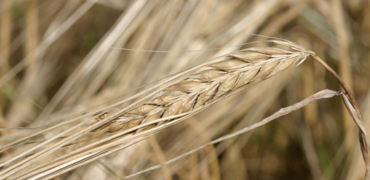
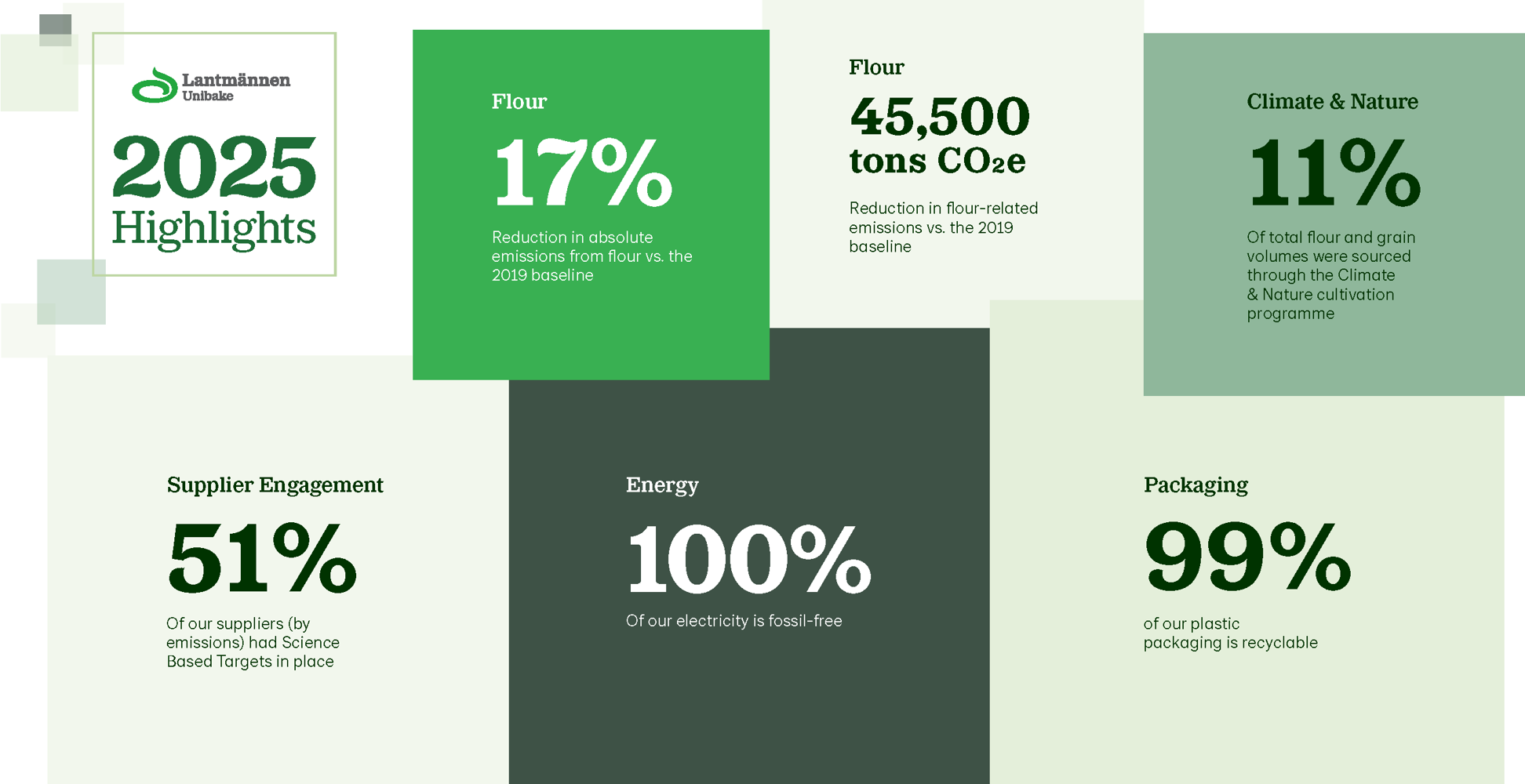
Flour remains our single biggest emission driver, accounting for 32% of our Scope 3 emissions. In 2025, emissions from grain and flour sourcing are down 16% compared to 2019 – corresponding to approximately 45,500 tons of CO₂e reduced. This progress is driven by long-term investment in more sustainable farming practices through the Climate & Nature programme.
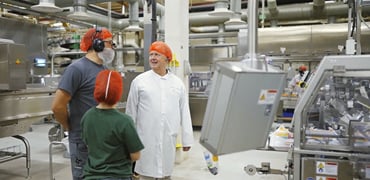
At the same time, operational improvements across our bakeries continue to deliver results. Combined Scope 1 and 2 emissions are down 39% since 2019, supported by energy efficiency initiatives and the transition to 100% fossil-free electricity across all sites.
Progress is also visible in how we engage across the value chain. By the end of 2025, 51% of our suppliers – measured by emissions – had committed to Science Based Targets. This reflects a deliberate shift towards embedding sustainability into procurement and supplier collaboration.
Climate progress at scale requires structure.
In 2025, more than 250 local initiatives across 14 countries were consolidated into a single transition plan. This plan connects actions across key emission areas – from energy and raw materials to logistics and packaging – and embeds climate considerations into how we budget, invest and make decisions as a business.
The validation of our Forest, Land and Agriculture (FLAG) targets by the Science Based Targets initiative further strengthens our focus on agricultural emissions and reinforces the importance of addressing climate impact at the source.
Where challenges remain
Not all parts of the value chain are moving at the same pace.
Transport emissions have decreased by just 1% since 2019, highlighting the structural challenges in decarbonising logistics. That is the part of our footprint most dependent on industry-wide transformation and one of our clear priorities for the years ahead.
A changing industry
The food industry is undergoing structural change. Expectations from customers, regulators and partners are evolving – and climate performance is increasingly becoming part of how companies are evaluated.
We believe that companies that understand and actively manage their emissions footprint will be better positioned as these changes accelerate.